Everything You Need to Know Before Riding a Motorcycle in Spain
Spain has long been one of the world’s top motorcycle touring destinations. The winding mountain passes of the Pyrenees, the famous hairpin bends of the Sierra Nevada, the scenic coastlines of Costa Brava and Costa del Sol, the endless roads of Andalusia, and the volcanic landscapes of the Canary Islands attract tens of thousands of motorcyclists every year from Europe, North America, Australia, New Zealand, South America, and Asia.
Whether you arrive on your own motorcycle or plan to rent one locally, you are required to comply with Spanish road traffic regulations. In many cases, these rules differ from those in other countries, and failing to know them can result in substantial fines, penalty points (for residents), or even vehicle impoundment.
Spain is one of the countries that consistently invests in road safety. This means frequent police checks, an extensive network of fixed and average-speed cameras, mobile patrols, helicopters, and drones monitoring traffic. Motorcyclists are one of the groups receiving particular attention, especially on popular tourist routes and mountain roads.
This guide has been specifically prepared for foreign motorcyclists visiting Spain. You will find up-to-date information on required documents, mandatory equipment, speed limits, roadside checks, types of speed cameras, fines, and practical tips to help you travel safely and in compliance with local laws.
Why Are Motorcyclists More Frequently Checked?
In Spain, motorcyclists are not treated more harshly than car drivers. However, accident statistics mean that the police and road authorities pay particular attention to them.
Weekend trips to the mountains, popular tourist routes, and coastal roads attract thousands of motorcyclists. These are precisely the areas where Guardia Civil de Tráfico and local authorities most frequently carry out checks.
During the motorcycle season, you may encounter patrols checking several things at once:
- speed,
- the motorcycle’s technical condition,
- exhaust noise levels,
- the validity of documents,
- the rider’s sobriety,
- how a passenger is being carried,
- use of a mobile phone while riding.
In practice, this means that even if you are riding in compliance with the regulations, you may be stopped for a routine check. This is a standard procedure and does not necessarily mean that you have committed an offence.
Who Must Comply with Spanish Traffic Regulations?
This is a question that frequently comes up among tourists.
The answer is very simple.
Every driver using public roads in Spain is subject to Spanish traffic law, regardless of:
- country of origin,
- nationality,
- country of motorcycle registration,
- type of driving licence.
It does not matter whether you have arrived from Germany, Poland, France, the United Kingdom, the United States, Canada, Australia, New Zealand, or Japan. As soon as you enter Spanish roads, you are required to comply with local regulations.
Is a Foreign Driving Licence Valid in Spain?
This is one of the most frequently asked questions by people planning a motorcycle trip through Spain.
The answer depends on the country where the driving licence was issued.
Drivers from the European Union and European Economic Area
A driving licence issued by an EU or EEA member state is recognised throughout Spain. There is no need to obtain any additional documents or an International Driving Permit.
Drivers from the United Kingdom
UK driving licences are recognised during tourist stays. However, those planning a longer stay should check the current requirements regarding residency.
Drivers from the USA, Canada, Australia, and Many Other Countries
For short tourist stays, many motorcycle rental companies accept national driving licences. However, in practice, it is recommended to carry an International Driving Permit (IDP). This document provides an official translation of your national driving licence and may be required by the police, your insurer, or the rental company.
Practical tip: Before travelling, check the requirements applicable to the country that issued your driving licence, as well as the motorcycle rental company’s policy. Carrying an IDP can often make formalities easier and help avoid misunderstandings during roadside checks.
Documents You Should Always Carry With You
During every motorcycle ride, it is advisable to keep the following documents readily accessible:
- a valid driving licence for the appropriate category,
- a passport or identity card (if accepted as a travel document),
- an International Driving Permit (if required or recommended),
- the motorcycle’s documents,
- proof of insurance,
- rental documents (if riding a rental motorcycle).
Although much of this information is now available through electronic systems, foreign drivers should carry the original documents or officially accepted versions with them.
What Is a Roadside Check Like in Spain?
For many tourists, their first roadside check in a foreign country can be stressful. In reality, checks carried out by Spanish authorities are generally calm and professional.
After being stopped, you should:
- safely pull over to the roadside or the location indicated by the officer,
- switch off the engine,
- remove your gloves (recommended),
- wait for the officer’s instructions,
- have the required documents ready.
The officer may ask for:
- your driving licence,
- your identity document,
- the motorcycle’s documents,
- proof of rental,
- a breathalyser test,
- an inspection of the motorcycle’s technical condition.
Most roadside checks take only a few minutes and end once the documents have been verified.
Mandatory Motorcycle Equipment in Spain
One of the most common questions foreign motorcyclists ask before travelling to Spain is:
“What do I need to carry with me and have on my motorcycle to legally ride on Spanish roads?”
Regulations may differ from those in the rider’s home country. Therefore, it is worth checking the most important requirements before starting your journey.
During a roadside check, Spanish police do not focus solely on documents. Officers may also inspect the motorcycle’s technical condition and components that affect safety.
What Do Police Most Often Check During a Motorcycle Inspection?
During a roadside check, officers may pay attention to:
1. The Licence Plate
The motorcycle must have:
- a properly mounted licence plate,
- a clearly legible registration number,
- no obstruction or modifications.
Covering the licence plate, using unauthorised covers, or adding elements that make it difficult to identify the vehicle may result in a fine.
2. Exhaust System
This is one of the most frequently inspected components on touring and sport motorcycles.
Police officers may check:
- the exhaust silencer’s type approval,
- excessive noise,
- a removed catalytic converter,
- a modified exhaust system.
In Spain, a loud motorcycle may attract the attention of a patrol even if the rider has not exceeded the speed limit.
Popular modifications that may be tolerated in other countries can cause problems in Spain:
- riding without a dB killer,
- a non-homologated aftermarket exhaust,
- a modified emissions system.
Tip for motorcycle renters: always make sure that the motorcycle you receive has a legal, type-approved exhaust system.
3. Lighting
The following may be inspected:
- the front headlight,
- the rear light,
- turn signals,
- the brake light,
- the correct operation of the electrical system.
Non-approved additional LED lights may be grounds for a traffic stop.
4. Mirrors
The motorcycle must have all equipment required by law.
Popular modifications, such as:
- removing the mirrors,
- small sport mirrors without type approval,
- modified mounting brackets,
may be challenged during a roadside inspection.
5. Tyres
Tyre condition is particularly important in a country like Spain, where motorcyclists often cover long distances in high temperatures.
Police may pay attention to:
- tread wear,
- visible damage,
- incorrect tyre size,
- non-compliance with the motorcycle’s type approval.
Worn tyres can be particularly dangerous when riding on mountain roads with sharp bends.
Does a motorcyclist have to carry a reflective vest?
This is a common question among riders arriving from other European countries.
For motorcycles in Spain, a reflective vest is not normally mandatory equipment during regular riding.
However:
- it is highly recommended,
- it improves safety in the event of a breakdown,
- it can be useful when stopping on a road outside built-up areas,
- it is worth carrying during night-time rides.
For motorcyclists travelling through remote regions of Spain, such as the Pyrenees, Sierra Nevada or inland Andalusia, a small reflective vest takes up very little space but can significantly improve safety.
Is a first-aid kit mandatory on a motorcycle?
No.
Unlike in some European countries, motorcyclists in Spain are not required to carry a first-aid kit.
Nevertheless, many experienced motorcycle travellers carry a basic first-aid kit, especially when undertaking longer journeys.
Do You Need to Carry a Tyre Repair Kit?
It is not legally required.
However, when travelling by motorcycle in Spain, it is worth considering carrying:
- a tubeless tyre repair kit,
- a mini compressor,
- basic tools,
- a power bank,
- water.
Roadside assistance operates efficiently on popular tourist routes, but distances between towns can be considerable in mountainous areas.
Do You Have to Wear Motorcycle Protective Gear in Spain?
Yes. Spanish regulations for motorcyclists have been tightened, and current rules require not only a helmet but also additional protective equipment. In particular, protective gloves and full, closed footwear or other footwear providing adequate protection for the foot and ankle are now mandatory. These changes were introduced as part of new road safety regulations aimed at motorcycle and scooter users.
For tourists visiting Spain, this means that regardless of their country of origin, they must comply with local requirements. During roadside checks, officers may pay attention not only to documents and the motorcycle’s technical condition, but also to the protective equipment worn by the rider and passenger.
Mandatory Protective Equipment for Motorcyclists
When riding a motorcycle in Spain, you must have:
Helmet
A helmet is mandatory for both the rider and passenger.
It must be:
- type-approved,
- properly fitted,
- fastened while riding.
Contrary to some reports appearing in the media, jet (open-face) helmets have not been completely banned. They may still be used provided they meet the applicable type-approval requirements.
Protective Gloves
Protective gloves are now a mandatory part of a motorcyclist’s equipment. The purpose of this requirement is to reduce the number of hand injuries, which are among the most common injuries sustained in motorcycle crashes.
The use of gloves with CE protective certification is recommended.
Closed Footwear
Both the rider and passenger must wear full, closed footwear. Riding in sandals, flip-flops or other open footwear may result in a fine.
The best option remains motorcycle boots that protect the ankle and foot.
Is a Motorcycle Jacket Mandatory?
This is one of the most frequently asked questions by motorcyclists from the USA, Canada, Australia, the United Kingdom and Europe.
As of the publication date of this guide, Spain has not introduced a general requirement for all motorcycle users to wear a motorcycle jacket, motorcycle trousers or an airbag vest. The DGT has considered a number of such changes in recent years, but not all proposals have been implemented as binding regulations.
However, this does not mean that protective equipment should be taken lightly.
Spanish road safety authorities and motorcycle organisations recommend wearing full protective equipment, including:
- a protective jacket with armour,
- motorcycle trousers,
- motorcycle boots,
- gloves,
- back protectors,
- airbag vests.
When riding in the mountains, along the coast or on fast roads between cities, full protective equipment significantly reduces the risk of serious injuries.
Is an Airbag Vest Mandatory?
Not for most motorcyclists travelling in Spain.
In recent years, there have been numerous reports about plans to introduce mandatory airbag vests for all motorcycle riders. In practice, the regulations primarily concern training and examinations for higher licence categories. There is currently no general requirement for every tourist travelling by motorcycle in Spain to wear an airbag vest.
If you are planning a longer trip through the Pyrenees, Andalusia or the Canary Islands, however, an airbag vest is one of the best additional pieces of equipment for improving safety.
Are GoPro Cameras or Helmet Cameras Legal?
Yes.
Many motorcyclists visiting Spain use action cameras.
The following are permitted:
- recording your journey,
- mounting a camera on the motorcycle,
- documenting your trip.
However, keep in mind that:
- the camera must not restrict your field of vision,
- you must not operate it while riding,
- recordings should not violate other people’s privacy.
A camera can also be very useful as a record of what happened in the event of a road accident.
Speed Limits in Spain for Motorcyclists
Speeding is one of the most common reasons foreign motorcyclists receive fines in Spain. Many tourists assume that speed limits are similar to those in their home country, but in practice, the differences can be significant, and Spain has one of the most developed speed enforcement systems in Europe.
The most important rule is very simple:
Always follow the road signs. The limits shown below are general speed limits. If a different limit is posted on a particular road section, the posted sign takes precedence.
General Speed Limits for Motorcycles
| Type of road | Maximum speed |
|---|---|
| Motorways (Autopistas and Autovías) | 120 km/h |
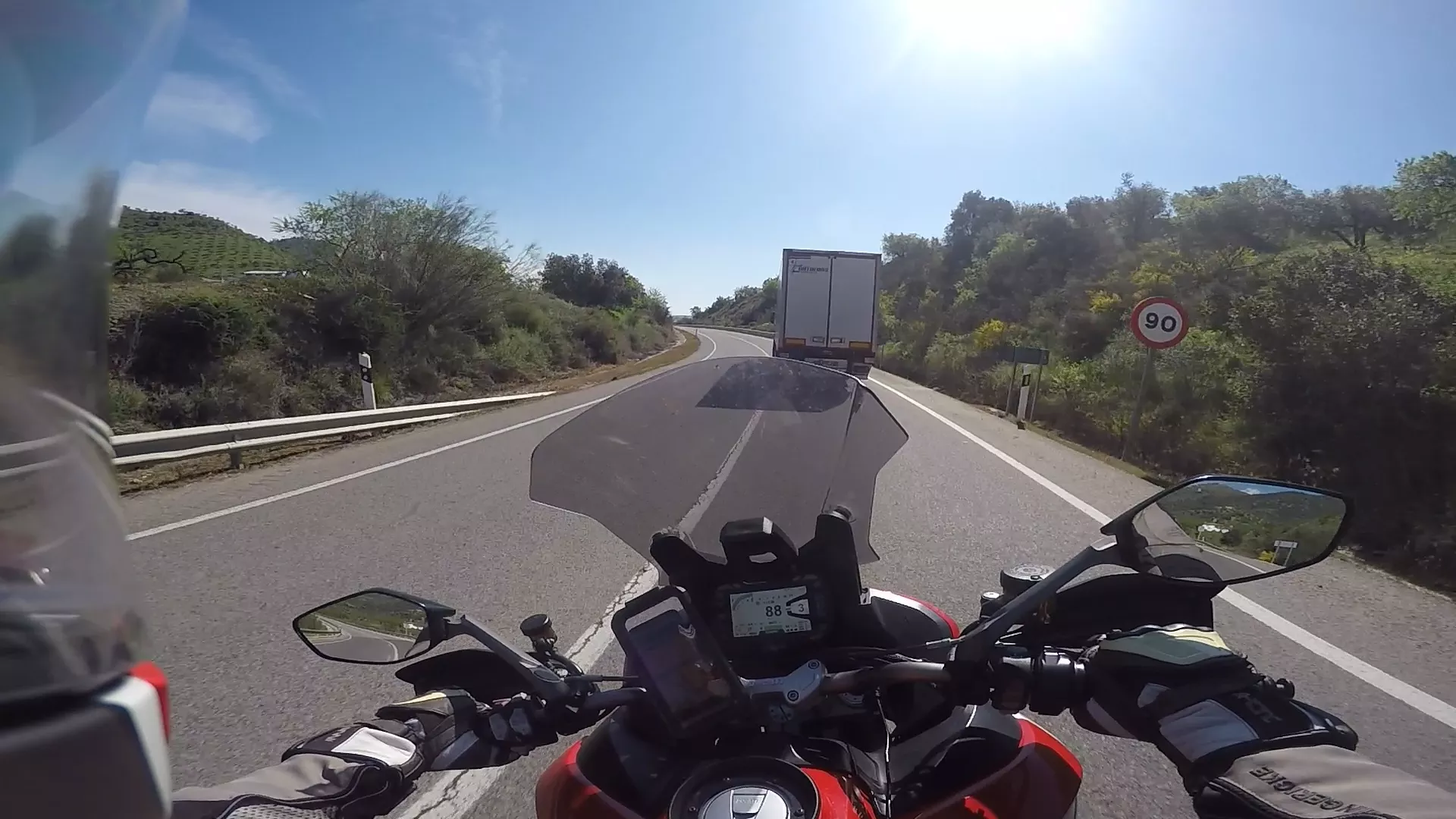
| Roads outside built-up areas (most conventional roads) | 90 km/h |
| Some conventional roads with physical separation of traffic directions or additional overtaking lanes* | 100 km/h |
| Urban roads with one lane in each direction | 30 km/h |
| Urban roads with two or more lanes in each direction | 50 km/h |
| Shared-space zones where pedestrians and vehicles use the same level | 20 km/h |
* The 100 km/h limit applies only to appropriately signposted roads that meet the requirements set out in the regulations. In most cases, roads outside built-up areas have a limit of 90 km/h.
Don’t Assume That a Wide Road Means a Higher Speed Limit
This is one of the most common mistakes made by foreign motorcyclists.
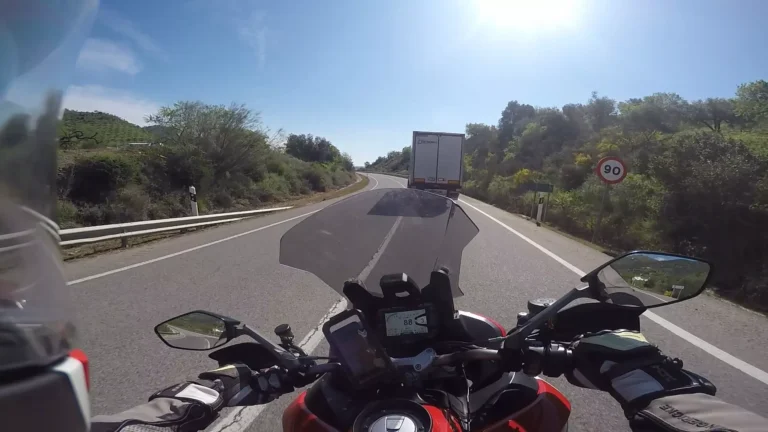
In Spain, many wide, well-maintained roads look like expressways, but they may still have a speed limit of 90 km/h. This is particularly common on roads through rural areas, mountainous regions and sections with a higher accident risk.
If a road has two lanes in the same direction or a physical separation between carriageways, the limit may be 100 km/h, but only when permitted by the regulations and indicated by the road signs. If in doubt, always follow the posted signs.
Speed Limits in Urban Areas
In recent years, Spain has significantly reduced speed limits in urban areas to improve the safety of pedestrians and cyclists.
There are three basic limits:
- 20 km/h – on streets where the carriageway and pavement are at the same level (shared-space zones),
- 30 km/h – on streets with one lane in each direction,
- 50 km/h – on streets with at least two lanes in the same direction.
In many towns and cities, you will also encounter 30 km/h zones covering entire residential neighbourhoods rather than just individual streets.
Mountain Roads – Where Motorcyclists Most Often Receive Fines
Spain is famous for having some of the best motorcycle routes in Europe. The Pyrenees, Sierra Nevada, Cantabrian Mountains and the islands offer hundreds of kilometres of spectacular bends.
At the same time, these are areas where police frequently carry out speed checks.
On mountain roads, you will often encounter limits of:
- 70 km/h,
- 60 km/h,
- 50 km/h,
- and on tight hairpins, even 30–40 km/h.
These limits are based on restricted visibility, steep descents, the high number of motorcyclists and the presence of cyclists. They should not be ignored – Guardia Civil regularly conducts enforcement operations on precisely these types of road sections.
Minimum Speed on Motorways
It is worth remembering that motorways have not only a maximum speed limit but also a minimum speed.
If road conditions allow, vehicles should not travel slower than 60 km/h. Driving excessively slowly without a valid reason may be considered a safety hazard and could result in enforcement action.
Speed Cameras and Speed Enforcement in Spain – What Motorcyclists Need to Know
Spain has one of the most extensive speed enforcement systems in Europe. Foreign motorcyclists most often receive fines not because they deliberately break the rules, but because they are unfamiliar with local enforcement methods.
In Spain, speed can be monitored using:
- fixed speed cameras,
- average speed cameras,
- mobile speed cameras,
- handheld laser speed meters,
- unmarked patrol cars,
- Pegasus helicopters,
- DGT drones.
Fixed Speed Camera (radar fijo)
This is the most traditional form of speed enforcement.
Fixed speed cameras are most commonly located:
- before tunnels,
- at entrances to towns and cities,
- on roads with a high number of accidents,
- on motorways and expressways.
Many cameras are preceded by signs warning of speed enforcement, but you should not assume that every camera will be clearly visible from a long distance.
Average Speed Cameras (radar de tramo)
This is one of the most important enforcement systems for motorcyclists to be aware of.
The system does not measure your instantaneous speed. Instead, it calculates your average speed over the entire monitored section.
For example:
- entry to the section: camera A,
- exit from the section: camera B,
- the system calculates your travel time.
If you complete the section faster than the applicable speed limit allows, a fine can be issued automatically.
Typical locations include:
- long tunnels,
- mountain roads,
- sections with a high accident rate.
Mobile Guardia Civil Speed Cameras
These are among the most difficult speed checks to predict.
Mobile speed cameras may be positioned:
- in marked patrol vehicles,
- in unmarked cars,
- behind road barriers,
- on the roadside,
- in parking bays.
They are particularly common:
- at weekends,
- on popular motorcycle routes,
- in mountainous areas,
- during public holidays.
Motorcyclists travelling in a group should remember that the police may measure the speed of a specific individual vehicle rather than the entire group.
Unmarked Patrol Cars
Spain uses a large number of unmarked patrol vehicles.
They can:
- record traffic violations,
- measure speed,
- document dangerous behaviour,
- stop a driver several kilometres later.
Do not assume that an ordinary-looking car in front of you is simply another road user.
Pegasus Helicopters
Pegasus is one of the DGT’s best-known traffic enforcement systems.
Helicopters equipped with specialised cameras can monitor:
- speed,
- dangerous overtaking,
- failure to maintain a safe following distance,
- mobile phone use,
- crossing solid lines.
For motorcyclists, it is particularly important to remember that the system can monitor behaviour on winding mountain roads, where aggressive riding is more likely to occur.
DGT Drones
Drones are used mainly to monitor traffic.
They most commonly detect:
- using a phone while riding,
- failing to maintain a safe distance,
- dangerous manoeuvres,
- driving in prohibited areas.
Not all drones are used to measure speed, but footage recorded by their cameras can be used as evidence for issuing a fine.
Can you use apps that warn you about speed cameras?
Yes, but it is important to distinguish between two types of devices.
Legal:
✅ navigation apps showing known speed-camera locations,
✅ information about speed cameras published by the DGT.
Illegal:
❌ radar detectors,
❌ devices designed to interfere with or jam radar signals.
Possessing or using prohibited devices can result in a substantial fine.
How should a motorcyclist ride in Spain to avoid a fine?
The most important rules are:
- do not exceed the speed limit on empty roads – speed cameras are often located there,
- slow down before entering tunnels,
- assume that speed checks may be carried out on mountain roads,
- do not ride “too fast”, even if local riders do,
- be particularly careful at weekends.
The biggest mistake made by foreign motorcyclists is treating Spanish roads as places where they can safely test their motorcycle’s performance. Spain offers fantastic riding routes, but the authorities actively monitor the most popular sections.
Speeding Fines in Spain – Current Penalties for Motorcyclists
In Spain, the amount of a speeding fine depends on how many kilometres per hour the applicable speed limit has been exceeded.
Administrative penalties include:
- €100 – the lowest penalty for minor speeding offences,
- €300 – more serious speeding + possible 2 penalty points,
- €400 – greater speeding offence + 4 penalty points,
- €500 – very serious speeding offence + 6 penalty points,
- €600 – the most serious offences + 6 penalty points.
Examples for Motorcyclists
120 km/h limit (motorway)
| Motorcycle Speed | Fine |
|---|---|
| 121–150 km/h | €100 |
| 151–170 km/h | €300 + 2 points |
| 171–180 km/h | €400 + 4 points |
| 181–190 km/h | €500 + 6 points |
| Over 191 km/h | €600 + 6 points |
90 km/h limit (typical road outside built-up areas)
| Motorcycle Speed | Fine |
|---|---|
| 91–120 km/h | €100 |
| 121–140 km/h | €300 + 2 points |
| 141–150 km/h | €400 + 4 points |
| 151–160 km/h | €500 + 6 points |
| Over 161 km/h | €600 + 6 points |
Do Tourists Receive Penalty Points?
This depends on the country that issued the driving licence and the driver’s status.
The Spanish penalty-point system primarily applies to drivers holding Spanish licences or those registered in information-exchange systems between countries.
For a foreign motorcyclist, the most important consequences are usually:
- a substantial financial fine,
- possible confiscation or retention of documents in certain circumstances,
- problems continuing the journey if the offence is serious.
When Does Speeding Become a Criminal Offence?
Certain speeding offences in Spain cease to be ordinary administrative violations and may be classified as road traffic crimes.
This applies when a driver exceeds:
- the applicable speed limit in a built-up area by more than 60 km/h,
- the applicable speed limit outside a built-up area by more than 80 km/h.
In such cases, the matter may be referred to court and result in significantly more serious consequences than a standard fine.
Discount for Paying a Fine Quickly
Many fines issued by Spanish authorities can be paid with a 50% discount if they are paid within the specified period (usually within 20 days of receiving the notice).
However, keep in mind:
- accepting the discount means waiving the right to appeal,
- the deadline and payment method may depend on the type of fine and the authority that issued it.
The Most Important Things to Remember Before Your Trip
Travelling by motorcycle in Spain is a unique experience, but it is worth remembering that traffic regulations and enforcement practices may differ from those you are familiar with in your home country.
Foreign motorcyclists most often run into problems because they are unfamiliar with local speed limits, have inappropriate equipment, or do not know how Spanish traffic checks are conducted.
If you take care of your documents, protective gear, motorcycle condition and basic knowledge of the local regulations before setting off, all that remains is to enjoy the ride.
Below you will find answers to the most frequently asked questions from motorcyclists planning a trip to Spain or looking to rent a motorcycle there.
FAQ – Frequently Asked Questions from Motorcyclists
Is a foreign driving licence valid in Spain?
Yes, provided it meets the requirements applicable to tourists. Drivers from outside the EU should check whether they need an International Driving Permit (IDP).
Do you need to carry a high-visibility vest on a motorcycle in Spain?
It is not standard mandatory motorcycle equipment, but it is highly recommended when travelling outside urban areas.
Can you use a motorcycle intercom?
Yes, approved helmet communication systems are permitted.
Can you record your ride with a GoPro?
Yes, provided that the camera does not compromise safety and is not operated while riding.
Is Spain safe for motorcyclists?
Yes. It is one of the best countries in Europe for motorcycle touring. However, you should follow local regulations and be aware of frequent traffic checks.
Rent a Motorbike and Discover Spain from the Rider’s Seat
The best way to experience Spain is at your own pace – riding through mountain passes, along coastal roads and to places that are inaccessible to large tourist groups.
Before setting off, it is worth choosing a reputable rental company, a properly maintained motorcycle and the right riding equipment.
Motorland.rent helps motorcyclists from around the world discover Spain safely and comfortably, offering motorcycles prepared for local conditions and support for tourists planning motorcycle adventures.
See you on the Spanish roads!